The Nightmare Technique a French Marquis Invented in 1851 — And Why It Took Science 130 Years to Catch Up
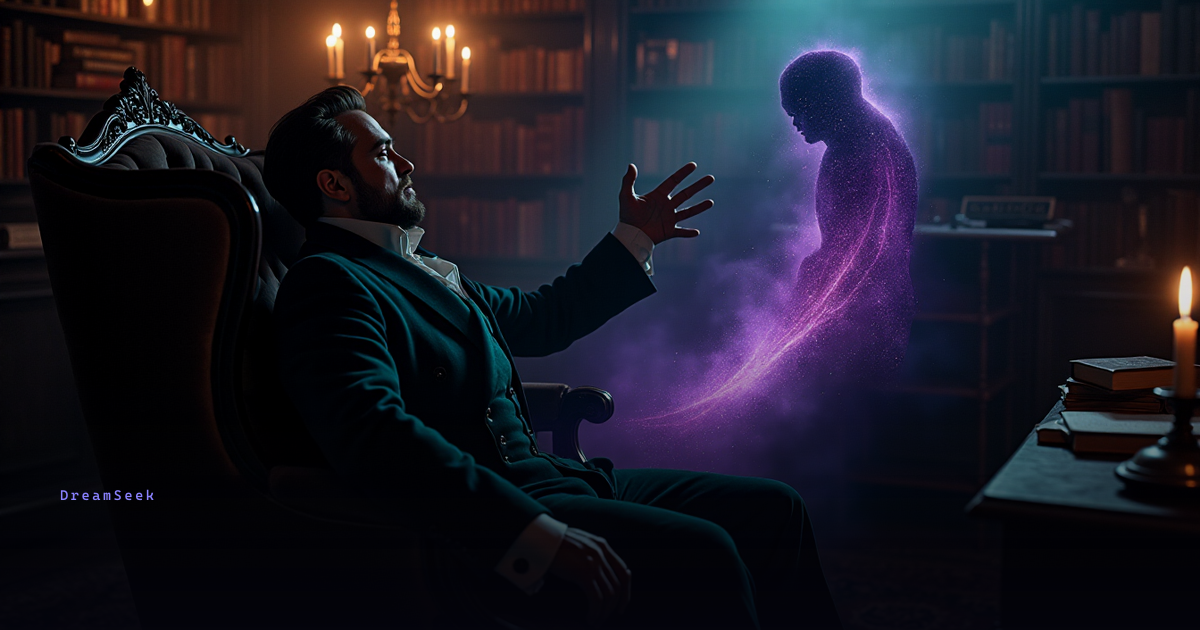
In 1851, a young Marquis in Paris was being chased through an endless series of rooms by "abominable monsters." The dream had come for the fourth time. The doors opened for him; he fled through; the doors would not stay shut behind him; the procession caught up. He always woke breathless and bathed in sweat.
On this fourth return, something changed. Mid-flight, he recognized the dream. He stopped running. He turned, set his back against the wall, and made a deliberate decision: instead of escaping, he would study what was chasing him.
"The first moral shock was violent enough, I admit," he wrote in his journal the next morning. "So much has even a forewarned mind difficulty defending itself against a dreaded illusion." But he held his ground. He counted the claws of the principal monster — seven on one hand. He noted the hairs of its brows, a wound on its shoulder. He catalogued the demon like a naturalist cataloguing a specimen.
As he watched, the monster's companions vanished. The monster itself began to slow. It lost its definition. It became "cottony." It turned into "a kind of floating husk, like those faded costumes that serve as signs for carnival-costume shops." A few insignificant scenes followed. He woke.
The nightmare never returned.
The man who published the book
The Marquis's name was Marie-Jean-Léon d'Hervey de Saint-Denys, and he published this account in 1867 in a book called Les rêves et les moyens de les diriger — "Dreams and the Means of Directing Them." Because the subject was considered unserious for a man who would later become Professor of Chinese at the Collège de France, he published anonymously. The first edition was small, disappeared quickly, and was not reprinted in France until the 1960s. Sigmund Freud, writing The Interpretation of Dreams in Vienna in 1899, tried to get a copy and couldn't find one — he had to rely on second-hand citations.
The book was based on 26 years of dream journaling. Saint-Denys had begun keeping a dream diary at age 12, in 1835. By the time of publication he had recorded more than 1,500 dreams, many with careful drawings. He is the man who, more than anyone else, invented the systematic study of lucid dreaming — though the term "lucid dream" wouldn't be coined until Frederik van Eeden used it in 1913, nearly half a century later.
What he actually did, in his own words
Here is the key passage, translated from his French journal entry, dated to roughly March 1851 from context clues:
"I did not have the awareness that I was dreaming, and I believed myself pursued by abominable monsters. I was fleeing through an endless series of rooms in a row, always having difficulty opening the dividing doors, and only closing them behind me to hear them opened again by this hideous procession which was trying to reach me and which was uttering horrible cries. I felt myself being outpaced in speed; I woke with a start, breathless and bathed in sweat.
"What had been the origin and the point of departure of this dream, I do not know; it is probable that some pathological cause engendered it for the first time. But afterwards, on various occasions over the space of six weeks, it was evidently brought back by the sole fact of the impression it had left on me, and of the fear I instinctively had of seeing it return...
"One night, however, on its fourth return, and at the moment when my persecutors were about to begin their pursuit again, the sense of truth suddenly awoke in my mind; the desire to combat these illusions gave me the strength to subdue my instinctive terror. Instead of fleeing, and by a voluntary effort assuredly very characterized in this circumstance, I therefore backed myself against the wall, and I resolved to contemplate with a fruitful attention the phantoms that till then I had rather glimpsed than looked at."
The move — stop, turn, face, attend — is compressed into two clauses. "The sense of truth suddenly awoke in my mind" (le sentiment de la vérité se réveilla tout à coup dans mon esprit) is the recognition of the dream-state, what modern lucid-dreamers call becoming lucid. "I backed myself against the wall, and I resolved to contemplate with a fruitful attention" (je m'adossai donc contre la muraille, et je pris la résolution de contempler avec une attention fructueuse) is the technique.
That's the entire nightmare-ending intervention. Recognize. Stop. Turn. Attend.
Why this was — and is — radical
For most of human history, the accepted wisdom about nightmares was that you endured them, waited for them to pass, or prayed to whatever god was appropriate. In the Hebrew Bible, a bad dream could be countered by a ritual (Berakhot 55b: "Three things require mercy: a good king, a good year, and a good dream"). In medieval Europe, recurring nightmares were sometimes attributed to the mare — a malevolent supernatural entity that sat on the sleeper's chest — and were countered by charms, crucifixes, horseshoes over the bed.
What Saint-Denys proposed instead was a cognitive intervention performed from inside the dream itself. No ritual object. No external help. No prayer. Just a mental move: recognize, stop, face, attend.
He was claiming — in 1867, without experimental backing — three things:
- The dreaming mind is trainable. Through the discipline of dream-journaling and pre-sleep intention, the dreamer can cultivate in-dream awareness that the dream is a dream.
- The nightmare's power depends on the dreamer's flight. The pursued-by-monsters structure requires the dreamer to be pursued. If the dreamer stops fleeing, the structure breaks.
- Sustained attention dissolves dream-threats. The monster that looks terrifying in a glimpse becomes burlesque when studied carefully. Saint-Denys's monster lost distinctness, became "cottony," turned into a carnival costume.
Each of these claims would be independently verified — by different researchers working in different frameworks — over the next 130 years.
The long delay
Why did it take so long for the technique to reach mainstream practice?
First, the book genuinely disappeared. Saint-Denys's anonymous publication, small initial print run, and lack of reprint for a century meant that between 1870 and 1960, the work was nearly invisible. Freud knew of it secondhand. Jung doesn't appear to have read it at all. It was Stefan Zweig, of all people, who kept a copy in his personal library and passed it on to the French psychical-research community in the 1920s.
Second, the 20th century had other preoccupations. Freud's interpretation paradigm — dreams as disguised wish-fulfillment, requiring unmasking by a trained analyst — dominated the first half of the century. Nightmare-treatment under the Freudian frame meant psychoanalysis: find the repressed wish, bring it to consciousness, integrate. This is a waking intervention, not a dream-interior one. Saint-Denys's technique didn't fit.
Third, scientific legitimacy for lucid dreaming didn't arrive until 1980, when Stephen LaBerge at Stanford published experimental evidence that dreamers could communicate with waking observers from within REM sleep by using pre-arranged eye-movement signals. This was the validation. Before 1980, anyone reporting in-dream awareness could be dismissed as describing incomplete waking; after 1980, the phenomenon was empirically confirmed. Saint-Denys had been right, in every operational detail, for 113 years.
Fourth, Jung's analogous technique emerged in the 1910s-1920s under the name active imagination. Jung's work involved engaging dream-figures as semi-autonomous presences, allowing them to speak, asking them questions. The Jungian version was done in waking life — the dreamer would remember the dream-figure and dialogue with it on paper or in reverie — but the core move (don't flee, face, inquire) is the same as Saint-Denys's. Jung does not cite Saint-Denys. He appears to have arrived at the technique independently. This is consistent with Saint-Denys's own prediction: the technique is empirically discoverable by anyone who keeps a dream-journal with enough persistence.
What modern research confirms
Three strands of 20th and 21st century research bear out Saint-Denys's specific claims:
1. Image Rehearsal Therapy (IRT). Developed by Barry Krakow and colleagues in the 1990s for PTSD nightmares, IRT works by having the patient, in waking life, rewrite the nightmare with a new ending — often involving the dreamer turning and facing the pursuer. The patient then rehearses the new ending before sleep. Randomized controlled trials show IRT substantially reduces nightmare frequency in PTSD patients. The core intervention is Saint-Denys's, relocated from inside the dream to pre-sleep rehearsal.
2. Lucid dream nightmare treatment. Paul Tholey in Germany (1970s-80s) and Stephen LaBerge (1980s-present) have shown that patients with recurring nightmares can, through pre-sleep intention-setting, cultivate in-dream awareness and then deploy exactly Saint-Denys's technique: stop, turn, face, attend. Tholey's studies on "dialogue with dream characters" reproduce Saint-Denys's followup experiment — in which he tries to summon the monsters back after conquering them and finds he cannot. The nightmare's power does not survive confrontation.
3. Exposure therapy research. Emily Holmes and collaborators at Oxford, working on intrusive traumatic imagery, have shown that sustained attentive engagement with threatening imagery — whether waking or dreaming — reduces its emotional charge. This is Saint-Denys's "contemplate with a fruitful attention" in experimental dress. The monster loses distinctness, becomes cottony, becomes a costume.
The followup experiment
What's often missed about Saint-Denys's account is the second half. Having conquered the recurring nightmare, he wanted to know whether his will could summon the monsters back. Some time later, during another lucid dream, he tried:
"I recalled those monstrous apparitions that had so vividly impressed me formerly, by virtue of the terror they inspired in me. I tried to evoke them, searching for them well in my memory and wishing to see them again as strongly as I was able. This first attempt had no success. Before me at this moment there unfolded the entirely pastoral picture of a countryside gilded by a beautiful sun, in the middle of which I perceived harvesters and carts loaded with grain. Not the least spectre answered my call."
The nightmare couldn't be summoned back. Its power had been grounded in the dreamer's unreflective flight; once the flight ended, the monsters lost their purchase. The dream-threat was not an external entity that could be reinvoked; it was a state of the dreamer's own cognition that, once altered, stayed altered.
This is the key insight of the followup experiment, and it's the one modern trauma research most strongly corroborates. The recurring nightmare is not a visit from an external malevolence. It is a cognitive pattern the dreamer is instantiating. When the pattern is interrupted — even once, even briefly — the pattern can lose its grip.
What to do if you have a recurring nightmare
Saint-Denys's own prescription, simplified:
- Keep a dream journal. Every morning, before moving, recall and record. This is the base practice. Nothing else works without it.
- Note the recurring nightmare's specific structure. Where does it start? What triggers the flight? What are the distinctive details of the pursuer?
- Before sleep, set the intention. "If the nightmare comes tonight, I will recognize it and stop running." Don't strain. Let the intention be present as the last thought.
- If the nightmare comes and you become aware, don't flee. Turn. Set your back against something. Look at what is chasing you with curious, scientific attention. Count the details. Catalogue it.
- If the recognition doesn't come, try again the next night. Saint-Denys's own recognition failed three times before succeeding on the fourth.
The technique requires the dream-journaling foundation that Saint-Denys advocated as non-negotiable. Without the base practice, the in-dream recognition won't arrive. With it, the recognition becomes progressively more reliable — and the nightmare becomes, in his phrase, "an object of fruitful attention" rather than an unavoidable torment.
A 174-year-old technique. Still works.
The source: Marie-Jean-Léon d'Hervey de Saint-Denys, Les rêves et les moyens de les diriger (Paris: Amyot, 1867). A draft translation of the principal chapters, including the journal entries quoted above, is maintained in the Liminaut research corpus. The work remains in the public domain and deserves to be read in full by anyone seriously interested in dreams.