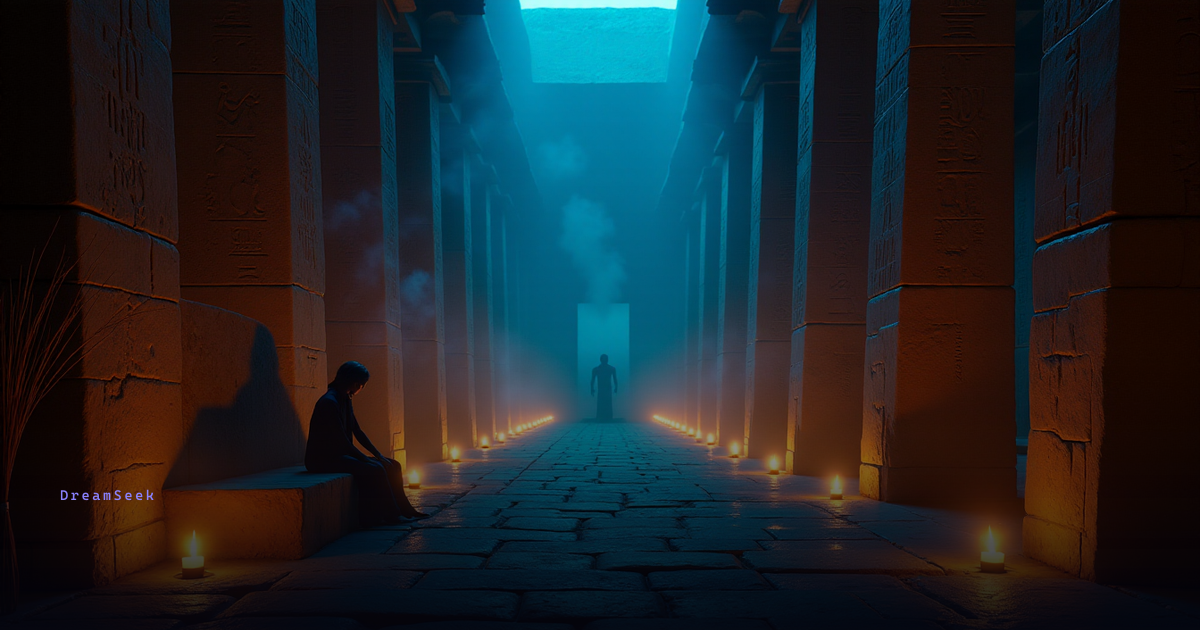
The Egyptian Dream Temples: 3,000 Years of Sacred Dreaming
The Egyptian dream temples represent humanity's oldest systematic attempt to harness the power of dreams — a tradition spanning over three millennia in which dreams were not idle curiosities but direct communications from the divine. Long before Freud lay on his couch in Vienna, before Artemidorus compiled his Oneirocritica in second-century Rome, the priests of ancient Egypt had developed a sophisticated technology of sacred dreaming: ritual purification, temple sleep, priestly interpretation, and the careful cataloguing of dream symbols in papyrus texts that survive to this day.
Egyptian dream incubation — the practice of sleeping in a sacred space to receive divine guidance through dreams — was not superstition. It was a state-supported institution embedded in the theological, medical, and political infrastructure of one of history's most enduring civilizations. Understanding how the Egyptians approached dreams reveals something that modern sleep science is only now rediscovering: that the conditions surrounding sleep profoundly shape what the dreaming mind produces.
The Dream Interpretation Engine includes Egyptian temple tradition as one of its 12 interpretive lenses — analyzing your dreams through the same symbolic categories the Ramesside scribes used, including dreamer typology, the Duat journey framework, and divine communication patterns. Try the Dream Interpretation Engine free →
The Ramesside Dream Book: The Oldest Dream Interpretation Text
The most remarkable surviving document of Egyptian dream practice is the Chester Beatty Papyrus III, commonly known as the Ramesside Dream Book, dating to approximately 1275 BCE during the reign of Ramesses II. The papyrus was found at Deir el-Medina, the village of artisans who built the royal tombs in the Valley of the Kings, and is now housed in the British Museum.
The text is organized with extraordinary methodical precision. Each entry follows a strict formula: "If a man sees himself in a dream [doing X], this is [good/bad]. It means [Y]." The entries are arranged in columns, with favorable dreams written in black ink and unfavorable dreams written in red — the color of Set, chaos, and danger.
What distinguishes the Ramesside Dream Book from later dream dictionaries is its systematic awareness of context. The text explicitly categorizes dreamers into two types — followers of Horus and followers of Set — and assigns different meanings to the same dream depending on which category the dreamer belongs to. A dream that is auspicious for a Horus-follower may be catastrophic for a Set-follower, and vice versa. This is not primitive thinking. It is a remarkably early recognition that dream interpretation requires knowledge of the dreamer's nature — an insight that would not be articulated with comparable sophistication until Jung, over three thousand years later.
Some representative entries from the papyrus:
- "If a man sees himself in a dream looking out of a window — good. It means the hearing of his cry by the god."
- "If a man sees himself in a dream with his bed catching fire — bad. It means driving away his wife."
- "If a man sees himself in a dream drinking warm beer — bad. It means suffering will come upon him."
- "If a man sees himself in a dream seeing a large cat — good. It means a large harvest will come to him."
The text also includes, remarkably, prescriptions for warding off bad dreams — rituals involving bread, fresh herbs, myrrh, and beer, consumed upon waking while reciting prayers to Isis. This is apotropaic magic, but it also reveals an understanding that the emotional residue of nightmares has real psychological consequences that require active management — a principle that modern nightmare treatment protocols like Image Rehearsal Therapy (IRT) would not formalize until the twenty-first century.
Horus-Followers and Set-Followers: Character and Dream Meaning
The Ramesside Dream Book's division of dreamers into followers of Horus and followers of Set deserves deeper attention, because it encodes a psychological insight of genuine subtlety.
Horus, the falcon-headed god, represented order, kingship, legitimate authority, and the daylight world. Set, his adversary, represented chaos, the desert, foreignness, storms, and transgressive power. A Horus-follower was understood to have a temperament aligned with order and social harmony. A Set-follower had a temperament aligned with disruption, intensity, and boundary-crossing.
The Egyptians did not moralize this distinction in the way later dualistic traditions would. Set was not "evil" in the New Kingdom theological framework — he was necessary. He defended Ra's solar barque against the serpent Apophis each night during its journey through the Duat. He was dangerous, volatile, and indispensable. A Set-follower was recognized as a legitimate psychological type — someone whose dreams operated by different rules.
This framework suggests that the Egyptians understood what personality psychology would later confirm: that the same stimulus produces different psychological responses depending on individual temperament. A dream of violence might represent cathartic release for one temperament and genuine warning for another. The Ramesside scribes knew this in 1275 BCE.
The Practice of Dream Incubation
The Temples
Dream incubation — enkoimesis in the later Greek adaptation — was practiced at numerous temples throughout Egypt, but several sites were particularly renowned:
Saqqara, the vast necropolis south of Cairo, housed a major dream incubation center associated with the worship of Imhotep (deified architect, physician, and sage of the Third Dynasty). Pilgrims traveled from across Egypt and, later, the Mediterranean world to sleep in the temple precinct and receive healing dreams. The archaeological record at Saqqara includes hundreds of votive offerings — clay ears (symbolizing the god "hearing" the supplicant), anatomical models of afflicted body parts, and stelae recording successful dream cures.
The Serapeum at Saqqara, originally dedicated to the Apis bull cult and later to the syncretic god Serapis, became one of the ancient world's most famous dream incubation sites. Under the Ptolemies, it drew Greek, Egyptian, and eventually Roman dreamers. The archive of Hor of Sebennytos, a second-century BCE priest who recorded his own dreams at the Serapeum over a period of years, provides an extraordinary firsthand account of dream incubation practice. Hor recorded prophetic dreams, divine visitations, and practical guidance received during temple sleep — a document of rare intimacy from the ancient world.
The Temple of Thoth at Hermopolis was associated with dream wisdom of a different character. Thoth, the ibis-headed god of writing, knowledge, and magic, was considered the inventor of dream interpretation itself. The Book of Thoth — a legendary text attributed to the god and referenced in numerous sources, though no single definitive copy survives — was said to contain the complete science of dream meaning. Dreams received at Thoth's temple were understood as communications of knowledge rather than healing — oracular rather than therapeutic.
The Ritual Process
The practice of temple dream incubation followed a structured ritual sequence, reconstructed from archaeological evidence, papyrus texts, and later Greek descriptions of the practice:
Purification: The dreamer underwent ritual cleansing — bathing in the sacred lake associated with the temple, abstaining from certain foods (particularly pork and fish from the Nile in some traditions), and refraining from sexual contact for a prescribed period, typically three days.
Fasting and prayer: The supplicant fasted or ate only prescribed ritual foods, then offered prayers and sacrifices to the temple deity. These were not generic prayers but highly specific petitions: "Grant me a dream concerning my illness," or "Show me the fate of my undertaking." The Egyptians believed that the precision of the request shaped the precision of the divine response.
Sacred sleep: The dreamer slept within the temple precinct — often in a specifically designated chamber called an abaton (a term borrowed from the later Greek adaptation). The sleeping space was considered a liminal zone between the world of the living and the realm of the gods. In some temples, the dreamer slept on an animal skin, recapitulating the symbolism of death and rebirth.
Priestly interpretation: Upon waking, the dreamer reported the dream to a temple priest trained in interpretation — a "master of the secret things" (hery sesheta). The priest's training encompassed not only the dream catalogues but the full theological and medical knowledge of the temple. Interpretation was not mechanical symbol-matching; it required the priest to understand the dreamer's petition, temperament, social position, and the specific deity invoked.
Ritual response: Based on the interpretation, the priest prescribed action — a healing regimen, a sacrifice, a pilgrimage, a behavioral change. The dream was not complete until it was enacted. This principle — that a dream demands a response in the waking world — is central to Egyptian dream theology and distinguishes it from merely passive interpretation.
The Duat: The Underworld as Dream Landscape
The Egyptian conception of the afterlife journey provides a profound framework for understanding dream experience. The Duat — the underworld through which the sun god Ra traveled each night between sunset and dawn — was simultaneously a cosmological space, a map of the afterlife, and a description of the dreaming mind.
The major funerary texts — the Book of the Dead (more accurately, the Book of Coming Forth by Day), the Amduat (Book of What Is in the Underworld), and the Book of Gates — describe the sun's nocturnal journey through twelve hours of darkness, each populated by deities, demons, gates, and transformative trials. The parallels to dream experience are striking and, Egyptian scholars believe, intentional:
- The journey begins with a descent into darkness — the transition from waking to sleeping consciousness.
- The traveler encounters autonomous figures who challenge, threaten, guide, and test — dream characters who operate independently of the dreamer's will.
- Knowledge of names provides power over these figures — a motif that resonates with the therapeutic insight that naming an emotion or complex reduces its unconscious grip.
- The journey culminates in rebirth at dawn — the return of consciousness, transformed by the night's passage.
The Egyptians did not distinguish sharply between the journey of the dead through the Duat and the journey of the dreamer through the night. Both were real traversals of the same imaginal territory. Sleep was a nightly rehearsal for death, and dreams were encounters with the same divine and demonic forces that the soul would face in its final passage. This gave dreaming an existential gravity that modern cultures have largely lost.
From Egypt to Greece: The Asklepieia
The most direct legacy of Egyptian dream incubation is the Greek Asklepieion — the healing temples dedicated to Asklepios, god of medicine, where patients underwent enkoimesis (temple sleep) to receive curative dreams. The largest and most famous was at Epidauros in the Peloponnese, but over 300 Asklepieia operated across the ancient Mediterranean.
Classical scholars — notably C. A. Meier in Healing Dream and Ritual (1967) and Gil Renberg in Where Dreams May Come (2017) — have demonstrated the direct transmission from Egyptian to Greek practice. The cult of Serapis at the Serapeum explicitly merged Egyptian Osiris-Apis worship with Greek healing dream practices. The god Imhotep was identified with Asklepios. The ritual structure — purification, fasting, petition, sacred sleep, priestly interpretation — transferred almost intact.
The Greek Asklepieia added important innovations: the recording of successful dream cures on stone stelae (the iamata of Epidauros are among our richest sources), the use of therapeutic baths and theater as preparatory techniques, and the philosophical elaboration of dream theory by thinkers like Aristotle (On Dreams, On Divination in Sleep) and later Artemidorus (Oneirocritica).
But the root is Egyptian. When a patient at Epidauros lay down in the abaton and prayed for a healing dream, they participated in a tradition that stretched back at least a thousand years to the temple precincts of Saqqara and Memphis.
Dreams as Bridge Between Living and Dead
A dimension of Egyptian dream belief that has no modern Western parallel is the conviction that dreams provide direct communication with the deceased. The dead were not gone — they inhabited the Duat, a realm accessible to the living through dreams. Letters to the dead, inscribed on bowls and papyri and placed in tombs, frequently request that the deceased appear in a dream to provide guidance, settle disputes, or explain the cause of illness.
The Letters to the Dead — a genre of Egyptian texts spanning from the Old Kingdom to the Late Period — reveal a culture in which the boundary between living and dead was permeable, and dreams were the primary crossing point. A widow writes to her dead husband asking him to appear in a dream and fight the spirit that is causing her illness. A son writes to his dead father requesting a dream visitation to resolve an inheritance dispute.
This was not mere ancestor worship. It reflected a sophisticated understanding of the continuity of relationship beyond death — a concept that modern grief research, particularly the work of Dennis Klass on "continuing bonds," has only recently validated. The Egyptian dream temples were, among other things, spaces where the bereaved could maintain contact with those they had lost.
What Modern Science Says About Dream Incubation
The ancient practice of dream incubation — setting an intention before sleep to dream about a specific topic — has been validated by modern experimental research. Deirdre Barrett, a psychologist at Harvard Medical School, has conducted the most rigorous studies of dream incubation to date. In her research published in Dreaming (1993) and expanded in The Committee of Sleep (2001), Barrett demonstrated that participants who focused on a specific problem before sleep were significantly more likely to dream about that problem, and that the dreams frequently contained novel solutions not available to waking thought.
Barrett's protocol is strikingly similar to the Egyptian method: formulate a clear question, hold it in mind during a quiet pre-sleep period, and record whatever dream imagery appears upon waking. The theological framework differs, but the technology is functionally identical.
Research on targeted memory reactivation (TMR) by Ken Paller and colleagues at Northwestern has shown that external cues presented during sleep can reactivate specific memories and bias dream content. While TMR uses sounds or scents rather than prayer, the underlying principle — that pre-sleep and during-sleep conditions shape dream content — is precisely what the Egyptian priests understood and systematically exploited.
Archaeological Evidence and Scholarly Reconstruction
It is important to distinguish between what we KNOW from primary evidence and what scholars have RECONSTRUCTED:
Primary evidence (high confidence):
- The Chester Beatty Papyrus III exists and has been translated — its content (dream interpretation lists organized by deity type) is directly attested (Gardiner, 1935, Hieratic Papyri in the British Museum)
- Architectural remains of incubation chambers at Saqqara, the Serapeum, and Dendara are archaeologically confirmed
- Votive inscriptions at healing temples record specific dream experiences (comparable to Epidaurus inscriptions, which number over 70 confirmed cases)
- The concept of the ba (soul-aspect) journeying during sleep appears in multiple independent texts spanning 2,000+ years
Reconstructed evidence (moderate confidence):
- The specific ritual sequence (purification → fasting → prayer → incubation → interpretation) is reconstructed from partial textual references and comparison with better-documented Greek practices. Gil Renberg (Where Dreams May Come, 2017) provides the most comprehensive scholarly reconstruction.
- The distinction between Horus-followers and Set-followers as dreamer types appears in the Chester Beatty Papyrus but its practical application in temple contexts is scholarly inference
Speculative (lower confidence):
- The experiential quality of what happened in the incubation chambers — whether participants actually dreamed meaningful dreams, experienced placebo-enhanced healing, or participated in staged ritual — cannot be determined from archaeological evidence alone
- Connections to later Hermetic and alchemical traditions, while plausible, involve significant scholarly debate
This distinction matters because much popular writing about Egyptian dream temples presents reconstruction as fact. The primary evidence is genuinely remarkable; it doesn't need embellishment.
Why the Oldest Dream Science Still Matters
The Egyptian dream temples embody three principles that modern dream science is still catching up to:
First, that the conditions surrounding sleep — physical environment, emotional state, intention, ritual preparation — profoundly shape dream content. The Egyptians did not treat dreams as random events to be interpreted after the fact. They actively cultivated the conditions for meaningful dreams. Modern research on sleep hygiene, dream incubation, and the effects of pre-sleep cognition on dream content confirms this approach.
Second, that dream interpretation requires knowledge of the dreamer. The Ramesside Dream Book's insistence on categorizing dreamers by type — Horus-follower or Set-follower — anticipates the modern understanding that personality, life context, and individual history are essential to accurate dream interpretation. A universal dream dictionary is as useless now as it would have been in Thebes.
Third, that dreams demand a response. The Egyptian dream was not complete until it was acted upon — through ritual, behavioral change, or creative expression. Modern therapeutic approaches to dreamwork, from Gestalt to Jungian to cognitive-experiential, consistently emphasize that interpretation without integration is incomplete. The dream is a call; the response is what matters.
Three thousand years ago, a pilgrim walked through the gateway of a temple at Saqqara, purified in the sacred lake, spoke a prayer into the darkness, and lay down to receive the voice of the god in sleep. Tonight, you will close your eyes and enter the same territory — the same darkness, the same autonomous images, the same possibility of encounter with something larger than your waking mind.
The technology has changed. The territory has not.
Related Articles
- Dream Incubation: What Harvard Research Reveals — The direct modern descendant of Egyptian temple practice, with Harvard data showing 50% success rates for directing dream content.
- Why Do We Dream? The Neuroscience Explained — Seven neuroscience theories that illuminate why the Egyptian approach to cultivating dream conditions actually works.
- Celtic Dream Interpretation: The Otherworld Within — Another tradition that maps an Otherworld journey during sleep, with striking parallels between the Celtic Annwn and the Egyptian Duat.
The Dream Interpretation Engine analyzes dreams through 12 interpretive traditions simultaneously — including the Egyptian temple tradition. It maps your dream imagery against the symbolic vocabulary of the Ramesside Dream Book and the Duat journey framework, showing where ancient Egyptian readings align with modern psychological approaches. Try the Dream Interpretation Engine free →
Frequently Asked Questions
What is an Egyptian dream temple?
An Egyptian dream temple was a sacred site where individuals practiced dream incubation — sleeping within the temple precinct after ritual purification, fasting, and prayer, with the intention of receiving divine guidance, healing, or prophecy through dreams. Major dream temples existed at Saqqara (associated with Imhotep), the Serapeum (associated with Serapis and the Apis bull), and the Temple of Thoth at Hermopolis. Trained priests interpreted the resulting dreams and prescribed ritual or behavioral responses. The tradition spanned from at least the New Kingdom (circa 1550 BCE) through the Ptolemaic and Roman periods, influencing Greek and Roman dream practices.
What is the Ramesside Dream Book?
The Ramesside Dream Book (Chester Beatty Papyrus III) is one of the oldest surviving dream interpretation texts in the world, dating to approximately 1275 BCE during the reign of Ramesses II. Found at Deir el-Medina in Egypt, it systematically catalogs dream symbols and their meanings, organized by whether the dreamer is a follower of Horus or a follower of Set. Favorable dreams are written in black ink, unfavorable in red. It also includes rituals for warding off the effects of bad dreams. The papyrus is now held in the British Museum.
Did the Greeks borrow dream incubation from the Egyptians?
Substantial evidence supports direct transmission from Egyptian to Greek dream incubation practices. The Greek Asklepieia — healing temples where patients slept to receive curative dreams from Asklepios — share their ritual structure (purification, fasting, sacred sleep, priestly interpretation) with earlier Egyptian temples. The Greek identification of Asklepios with the Egyptian Imhotep, and the syncretic Serapis cult that merged Egyptian and Greek dream practices at the Serapeum, provide direct historical links. Scholars including C. A. Meier and Gil Renberg have documented this transmission in detail.
Does dream incubation actually work according to modern science?
Yes. Harvard psychologist Deirdre Barrett's research, published in the journal Dreaming and in her book The Committee of Sleep, demonstrated that people who focus on a specific problem before sleep are significantly more likely to dream about that problem and to generate novel solutions through their dreams. Additional research on targeted memory reactivation (TMR) by Ken Paller at Northwestern has shown that external cues during sleep can bias dream content toward specific memories and themes. The core Egyptian insight — that intentional preparation shapes dream content — has been experimentally validated.
What did the Egyptians believe about dreams and the dead?
The Egyptians believed that dreams provided direct access to the deceased, who inhabited the Duat (underworld) — a realm the living could visit during sleep. The "Letters to the Dead," a genre of texts spanning thousands of years, show Egyptians writing to deceased relatives requesting dream visitations for guidance, healing, or dispute resolution. Dreams were considered the primary crossing point between the worlds of the living and the dead. This belief was not peripheral superstition but a central feature of Egyptian religion, reflected in funerary texts, temple practices, and personal correspondence throughout Egyptian history.