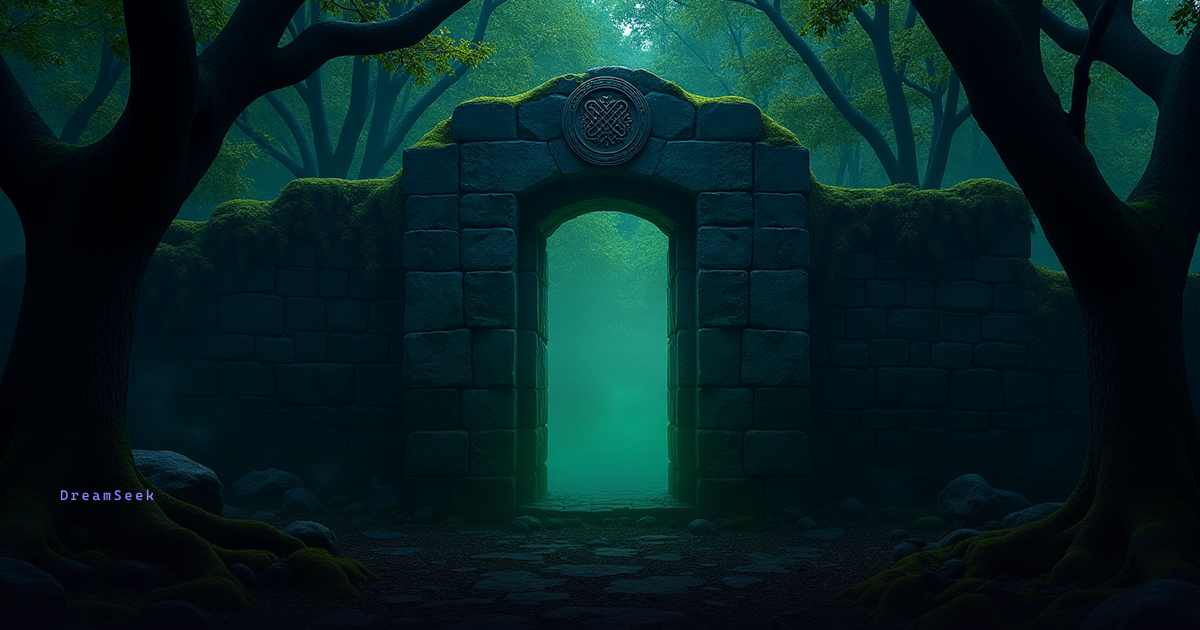
Celtic Dream Interpretation: The Otherworld Within
Celtic dream interpretation begins with a single radical premise: the Otherworld is not elsewhere. It is here, separated from ordinary awareness by a membrane as thin as mist over a lake at dawn. In the Celtic imagination, dreams are not random neurological byproducts or even messages from an unconscious mind — they are crossings. The dreamer passes through the veil between worlds and returns carrying knowledge, obligation, or transformation. This understanding, preserved in medieval Welsh and Irish texts that record much older oral traditions, offers a dream vocabulary of extraordinary richness: shapeshifting, thin places, sacred animals, enchanted trees, and prohibitions whose violation restructures fate.
What follows draws from primary medieval sources — the Mabinogion, the Irish mythological cycles, and early Celtic literary tradition — supplemented by scholarly analysis and literary criticism. We will be honest about what this material is and is not: it is a literary and mythological tradition, not an empirically tested interpretation system. Its value for modern dreamers lies in its unmatched symbolic vocabulary, particularly for those whose cultural roots draw from Celtic soil.
The Dream Interpretation Engine includes the Celtic Otherworld tradition as one of its 12 interpretive lenses — mapping your dreams for threshold imagery, shapeshifting symbolism, sacred animal presences, and Otherworld topology, then showing where Celtic readings converge with Jungian, Egyptian, and other traditions on your specific dream. Try the Dream Interpretation Engine free →
The Otherworld: Annwn, Tir na nOg, and the Dream Realm
The Celtic Otherworld goes by many names. In Welsh tradition, it is Annwn (sometimes Anglicized as Annwfn) — a realm of beauty, feasting, and timelessness ruled by Arawn, as recounted in the First Branch of the Mabinogion (Guest translation, 1849; scholarly edition by Davies, 2007). In Irish tradition, it is Tir na nOg (the Land of the Young), Mag Mell (the Plain of Delight), or simply the Sidhe — the hollow hills where the Tuatha De Danann retreated when the Milesians came.
The critical feature of the Celtic Otherworld, the one that makes it uniquely relevant to dream interpretation, is its proximity. It is not a distant heaven or a deep underworld. It is right here, overlapping with ordinary reality, accessible through:
- Thin places — locations where the boundary is especially permeable (islands, hilltops, holy wells, crossroads, shorelines)
- Thin times — Samhain (October 31 - November 1) and Beltane (May 1), when the veil is thinnest
- Liminal states — dawn, dusk, and sleep
This geography of proximity maps directly onto dream experience. The dream is a thin place. Every night, the dreamer crosses through a permeable boundary into a realm where time operates differently, where the dead walk, where animals speak, and where what happens carries consequences that persist upon return.
Yeats, drawing on living Irish folk tradition, described this proximity with characteristic precision in The Celtic Twilight (1893): "The boundary between this world and the other is always shifting... sometimes one world seems to melt into the other."
Dream Tales from the Mabinogion
The Mabinogion — a collection of Welsh prose tales compiled from medieval manuscripts (the Red Book of Hergest, c. 1382-1410; the White Book of Rhydderch, c. 1350) but containing material of much greater antiquity — includes two tales that are explicitly about dreaming. These are not merely stories that happen to involve dreams. They are sustained meditations on the nature of dream experience and its relationship to waking action.
The Dream of Macsen Wledig
The Roman emperor Macsen (based on the historical Magnus Maximus, d. 388 CE) falls asleep while hunting and dreams a journey: he travels along a river to a great harbor, crosses the sea to an island, traverses mountains, and arrives at a castle where he finds the most beautiful woman in the world. He wakes and is so stricken by the dream that he cannot eat, drink, or sleep until his messengers find the actual woman — Elen — and he marries her.
As a dream interpretation text, this tale articulates several principles:
-
The dream journey is geographically specific. Macsen's dream is not vague imagery but a precise route that can be followed in waking life. This suggests the Celtic understanding that dream space and physical space overlap — the dream maps onto the real landscape.
-
The dream creates obligation. Macsen does not treat his dream as an interesting experience. It commands him. He becomes ill until he acts on it. The dream is not information to be processed but a summons to be obeyed.
-
The anima quest. In Jungian terms (Jung, 1951, Aion), Macsen's dream is a classic anima projection — the inner feminine image projected onto a real woman who is then pursued across the world. The tale acknowledges both the power and the danger of this dynamic.
The Dream of Rhonabwy
This tale is more complex and more psychologically interesting. Rhonabwy, a warrior, falls asleep on a yellow ox-skin and dreams an elaborate vision of King Arthur and his court preparing for the Battle of Badon. The dream is so detailed, so strange, and so symbolically dense that the tale ends with a remarkable editorial note: "And this is the reason that no one, neither bard nor storyteller, knows the Dream without a book — by reason of the number of colors that were on the horses, and all the unusual colors both on the arms and their trappings, and on the precious mantles, and the magic stones."
The interpretive principles:
-
Dreams can be too complex for unaided memory. The tale explicitly acknowledges that dream content can exceed the dreamer's capacity to retain it — a recognition that modern dream researchers would endorse. Dream recall is partial by nature (Schredl, 2010, International Journal of Dream Research).
-
The dream comments on the present through the past. Rhonabwy's dream of Arthur is not nostalgic — it is a sardonic commentary on the degeneration of Welsh warrior culture. Dreams use historical and mythological imagery to address present concerns. This parallels the Jungian concept of amplification and the general principle that dream symbolism draws from the dreamer's cultural inheritance.
-
Color carries meaning. The emphasis on specific, unusual colors throughout the dream suggests that in Celtic dream tradition, color is not incidental but semantically loaded — an observation shared by many other traditions.
Ogham Tree Symbolism in Dreams
The Ogham alphabet — a system of linear marks used in inscriptions on stone monuments primarily in Ireland and western Britain (4th-7th centuries CE) — was associated in medieval Irish scholarly tradition with specific trees. While the historical evidence for Ogham as a full "tree alphabet" is debated (the medieval Auraicept na n-Eces and Book of Ballymote provide tree correspondences, but these may be scholarly elaboration rather than original meaning), the tree associations have become a rich source of symbolic vocabulary.
A note on Robert Graves: The influential White Goddess (1948) proposed an elaborate tree calendar based on the Ogham alphabet. Scholarly consensus is that Graves' system is largely his own invention, based on selective and sometimes inaccurate reading of sources (Hutton, 1991, The Pagan Religions of the Ancient British Isles). We present tree symbolism here from the medieval Irish sources, not from Graves' reconstruction, while acknowledging that Graves' system has been widely adopted in modern Celtic-influenced practice and has its own symbolic utility regardless of historical accuracy.
Trees frequently appearing in Celtic dream contexts, drawn from medieval sources:
- Oak (Dair): Sovereignty, endurance, the doorway between worlds. The word "druid" may derive from a Celtic root meaning "oak-knowledge" (dru-wid). Dreaming of oaks may indicate questions of personal sovereignty — where you stand, what you rule, what endures.
- Hazel (Coll): Wisdom, poetic inspiration, the salmon's food. The hazel trees overhanging the Well of Wisdom, whose nuts are eaten by the Salmon of Knowledge, form one of the core images of Irish mythology. Hazel in dreams may indicate wisdom available but not yet consumed.
- Yew (Idad): Death, transformation, extreme age, the ancestors. Yew trees in churchyards throughout the Celtic lands often predate the churches by centuries. Dreaming of yew may indicate ancestral connection or the kind of transformation that requires something to die.
- Birch (Beith): New beginnings, purification, the first letter of the Ogham alphabet. Birch forests in dreams may indicate fresh starts and the clearing away of the old.
- Rowan (Luis): Protection against enchantment, the threshold guardian. Rowan was planted at house doors throughout the Celtic world. In dreams, rowan may indicate the need for discernment about what energies to admit and which to ward.
Shapeshifting as Psychological Transformation
Shapeshifting is perhaps the most characteristic feature of Celtic mythology, and it carries profound implications for dream interpretation. In the Irish tradition, Tuan mac Cairill passes through the forms of stag, boar, hawk, and salmon, preserving human memory through each transformation. In the Welsh tradition, Gwydion and his brother are transformed into deer, pigs, and wolves as punishment. Taliesin passes through innumerable forms in his flight from Ceridwen.
The dream interpretation principle: When you shapeshift in a dream — when you become an animal, a tree, an element — you are not merely encountering a symbol. You are undergoing a transformation of identity. The Celtic tradition treats this with complete seriousness: Tuan's memories as a salmon are as real and as formative as his memories as a human.
This maps with striking precision onto Gestalt dream work (Perls, 1969), which invites the dreamer to become each dream element in first person. But the Celtic understanding adds a dimension Gestalt does not: the transformation is not merely a therapeutic exercise but a genuine expansion of identity. You are not pretending to be the hawk in your dream. You were the hawk, and the hawk's knowledge is now part of your experience.
Key shapeshifting animals in Celtic dream symbolism, drawn from primary sources:
The Salmon of Knowledge
From the Fenian Cycle: the Salmon of Knowledge swam in a pool beneath hazel trees, eating the nuts that fell into the water, and absorbing all the world's wisdom. Fionn mac Cumhaill gained this wisdom by touching the cooking salmon and putting his burned thumb in his mouth (from Macgnimartha Finn, a medieval Irish text).
In dreams: The salmon represents wisdom that has been gestating in deep waters (the unconscious) and is now ready to be tasted. Salmon dreams often arrive when a long period of not-knowing is about to break into sudden understanding. The salmon also represents the capacity to return to origins — salmon swim upstream to their birthplace — suggesting that the wisdom comes from going back to the source.
Ravens and Crows
The Morrigan, the Irish goddess of war, prophecy, and sovereignty, takes the form of a crow or raven. In the Welsh tradition, Bran the Blessed (whose name means "raven") is a giant-king whose severed head continues to prophesy. Ravens in Celtic tradition are not merely birds of ill omen — they are prophetic consciousness, the capacity to see what is coming, especially death and transformation.
In dreams: Ravens and crows indicate prophetic content — the dream is showing you something about the future, probably involving a difficult transition. They also indicate the presence of sovereignty issues: who has power, who is about to lose it, what old form is dying to make way for what comes next.
The Stag
Cernunnos, the antlered god depicted on the Gundestrup Cauldron (c. 150 BCE - 1 CE, National Museum of Denmark), sits cross-legged among animals, wearing antlers. The stag in Celtic tradition represents the wild masculine, the lord of the forest, the guide between worlds. Stags frequently appear in Celtic tales as guides who lead heroes into the Otherworld — the White Stag that, when pursued, draws the hunter deeper and deeper into the forest until ordinary reality is left behind.
In dreams: The stag is a psychopomp — a guide between worlds. If a stag appears in your dream, especially a white one, it is leading you somewhere. Follow it. The destination is more important than the animal itself. Stag dreams often indicate that a deepening of experience is available if you are willing to follow an instinct that leads away from the familiar.
The Triple Goddess and Developmental Dream Series
The maiden/mother/crone triad — while its specific formulation owes much to modern Wiccan and neopagan elaboration (drawing on Graves, 1948, with all the caveats noted above) — does reflect a genuine pattern in Celtic source material. The Irish Morrigan appears in triple form (Morrigan, Badb, Macha). The Welsh Rhiannon shifts between maiden and sovereign mother across the branches of the Mabinogion. Brigid has triple aspects (poetry, healing, smithcraft).
Applied to dream series: The triple goddess model suggests that a dream figure who recurs over months or years may be moving through developmental phases. A mysterious young woman in your dreams at age twenty may become a powerful maternal figure in your dreams at forty and a terrifying wise presence in your dreams at sixty — not three different figures but one figure showing three faces as you and she age together.
This developmental model aligns with Jungian observations about the anima/animus as a figure that matures through life stages (Jung, 1951, Aion; von Franz, 1972, The Feminine in Fairy Tales). The Celtic contribution is the explicit tripartite structure and the understanding that all three faces are present at all times — the crone is already present in the maiden; the maiden persists within the crone.
The Geas: Sacred Prohibitions and Dream Taboos
One of the most distinctive features of Celtic heroic tradition is the geas (plural geasa) — a sacred prohibition placed on an individual, the violation of which leads to catastrophe. Cu Chulainn's geasa included never eating dog meat (his name means "Hound of Culann") and never refusing hospitality. His enemies destroy him by placing him in a situation where two geasa conflict: he is offered dog meat by a host, and must either eat the forbidden food or refuse hospitality. The violation of the geas leads directly to his death (from Aided Con Culainn, "The Death of Cu Chulainn," in Lady Gregory's Cuchulain of Muirthemne, 1902).
The dream interpretation principle: Dreams sometimes establish prohibitions — things the dreamer is told not to do, places not to go, doors not to open. In the Celtic framework, these prohibitions are not obstacles but sacred structures. They define identity through limitation. The geas says: you are the person who does not do this thing. This is not restriction but definition.
When a dream establishes a taboo and the dreamer subsequently violates it (either in a later dream or in waking life), the Celtic model predicts transformation through crisis — not necessarily catastrophe, but a fundamental restructuring of identity. The old self, defined by the prohibition, dies. Something new, as yet undefined, begins.
This has no empirical parallel in dream research, but it resonates with clinical observations about dreams that establish "rules" for the dream world — rules that, when violated in subsequent dreams, often coincide with significant life transitions.
Evidence Level and Honest Assessment
What Celtic dream interpretation draws from:
- Medieval literary texts (the Mabinogion, the Irish mythological and heroic cycles) dating from the 11th-14th centuries CE in their written forms, but containing material of significantly greater antiquity
- Archaeological evidence (inscriptions, iconography, votive deposits) that confirms the importance of certain symbols (the stag, the raven, the triple form, the Otherworld journey)
- Ethnographic accounts of folk practice in Celtic-speaking regions, collected primarily in the 19th and early 20th centuries (Yeats, 1893; Evans-Wentz, 1911, The Fairy-Faith in Celtic Countries)
- Scholarly analysis and literary criticism (Rolleston, 1911; Rees & Rees, 1961, Celtic Heritage; Green, 1992, Dictionary of Celtic Myth and Legend)
What it does NOT draw from:
- Controlled empirical studies. No one has tested Celtic dream interpretation against other systems in a clinical setting.
- Living unbroken dream interpretation traditions. Unlike some Indigenous and Tibetan traditions, there is no continuous lineage of Celtic dream practitioners. The tradition is reconstructed from texts, archaeology, and folk memory.
- Graves' White Goddess tree calendar, which is widely used in modern practice but lacks scholarly support as a historical system.
The honest assessment: Celtic dream interpretation is a literary-mythological system — rich, beautiful, psychologically insightful, and without empirical validation. Its value for modern dreamers is as a symbolic vocabulary of exceptional depth, particularly for those with cultural roots in the Celtic world. It should be used as one lens among many, not as a definitive interpretive authority.
Related Articles
- Medicine Wheel Dream Meaning: The Four Directions — Another nature-based dream tradition built on animal teachers, directional symbolism, and cyclical transformation, with structural parallels to Celtic ecological dreamwork.
- Jungian Dream Analysis: The Complete Guide — Jung drew extensively on Celtic hero mythology in developing his individuation theory, and Jungian amplification enriches Celtic dream symbols with archetypal depth.
- Egyptian Dream Temples: 3,000 Years of Sacred Dreaming — The Egyptian Duat and the Celtic Otherworld share striking parallels as underworld dream landscapes — realms the dreamer traverses nightly between dusk and dawn.
The Dream Interpretation Engine analyzes dreams through 12 interpretive traditions simultaneously — including the Celtic Otherworld tradition. It identifies threshold imagery, shapeshifting motifs, sacred animal presences, and geas-like prohibitions in your dreams, showing where Celtic readings converge with Jungian, Egyptian, and other frameworks. Try the Dream Interpretation Engine free →
Practical Application: Reading Your Dreams Through Celtic Lenses
Step 1: Note threshold imagery. Is the dream set at a boundary? Shoreline, doorway, twilight, crossroads? If so, the dream may be a "thin place" dream — a crossing into Otherworld territory. Pay special attention to what lies on the other side.
Step 2: Identify animal presences. Celtic animals are not passive symbols — they are active agents. A salmon is offering wisdom. A raven is prophesying. A stag is guiding. Ask not "what does this animal represent?" but "where is this animal leading me?"
Step 3: Notice shapeshifting. If you or another figure changed form during the dream, the transformation itself is the message. What did you become? What capabilities does that form possess that your ordinary form lacks?
Step 4: Listen for prohibitions. Did the dream establish any rules, warnings, or taboos? These may be geasa — sacred limitations that define your path. Do not dismiss them as anxiety. Consider that they may be structural.
Step 5: Track the Otherworld topology. Over time, do your dreams map a consistent other-landscape? Many long-term dream journalers find that their dreams repeatedly visit the same imaginal places. In the Celtic frame, this is your personal Annwn taking shape — your Otherworld becoming increasingly real and navigable through repeated crossing.
Frequently Asked Questions
What makes Celtic dream interpretation different from other systems?
Celtic dream interpretation is distinctive in three ways. First, it treats the dream world as a real place (the Otherworld) rather than a psychological projection — dreams are crossings, not merely internal events. Second, it emphasizes shapeshifting — the dreamer's capacity to become other beings, gaining their knowledge and capabilities. Third, it uses the geas (sacred prohibition) as an interpretive structure, understanding dream taboos not as anxieties but as identity-defining sacred limits. These features arise from the Celtic literary tradition as preserved in medieval Welsh and Irish texts (the Mabinogion, Guest 1849; the Irish mythological cycles, Gregory 1902) and distinguish Celtic dreamwork from the more purely psychological approaches of Jungian or Gestalt traditions.
Is Celtic dream interpretation historically authentic or modern invention?
Both, honestly. The medieval texts (recorded 11th-14th centuries from older oral tradition) contain genuine dream lore: the Dream of Macsen Wledig and the Dream of Rhonabwy are sophisticated dream narratives that articulate interpretive principles. The animal symbolism and Otherworld cosmology are well-attested in primary sources and archaeology. However, the systematic application of these elements as a "dream interpretation system" is a modern reconstruction. There was no Celtic equivalent of Artemidorus writing a dream interpretation manual. We are assembling a practice from literary, archaeological, and ethnographic fragments — an honest and valuable endeavor, but not the recovery of an intact ancient system.
What do animal dreams mean in Celtic tradition?
Each animal carries specific significance. The salmon offers sudden wisdom after long gestation. Ravens and crows indicate prophecy and sovereignty transitions, associated with the Morrigan. The stag serves as a psychopomp guiding the dreamer deeper into Otherworld territory. Horses, especially white ones, are Otherworld messengers (Rhiannon's horse in the Mabinogion). Boars represent fierce, untameable power from the wild. The key principle is that Celtic dream animals are not passive symbols but active agents — they are doing something in the dream, and what they are doing matters more than what they "represent."
How does the Otherworld concept apply to modern dream interpretation?
The Otherworld (Annwn, Tir na nOg) provides a powerful frame for understanding dreams as visits to a real place rather than internal projections. Practically, this means: treat your dream landscape with the respect you would give to a foreign country you are visiting. Map it over time. Notice when you return to the same locations. Pay attention to the beings you meet there as inhabitants with their own agendas, not as parts of yourself. This ontological shift — from "my dream" to "the place I went" — can dramatically change the quality of dream engagement. It aligns with some Indigenous dream traditions and contrasts with purely psychological approaches. Whether the Otherworld is "real" in a materialist sense is unanswerable; whether treating it as real enriches dream experience is testable by any practitioner.
Can I use Celtic dream interpretation if I don't have Celtic ancestry?
The literary sources — the Mabinogion, the Irish cycles, Yeats, and the scholarly tradition — are published, widely available, and part of world literary heritage. Anyone can read and draw from them. However, symbolic systems tend to resonate most deeply when they connect to your cultural roots, family mythology, or personal sense of place. If you dream of salmon and stags and thin places and you feel the pull, the tradition is speaking to something in you, whatever your ancestry. If the symbolism feels foreign and forced, a different tradition's vocabulary may serve you better. The Celtic material is generous — it does not require credentials for entry — but like any symbolic system, it works best when it meets genuine resonance, not merely intellectual curiosity.