Medicine Wheel Dream Meaning: The Four Directions as a Map of the Psyche
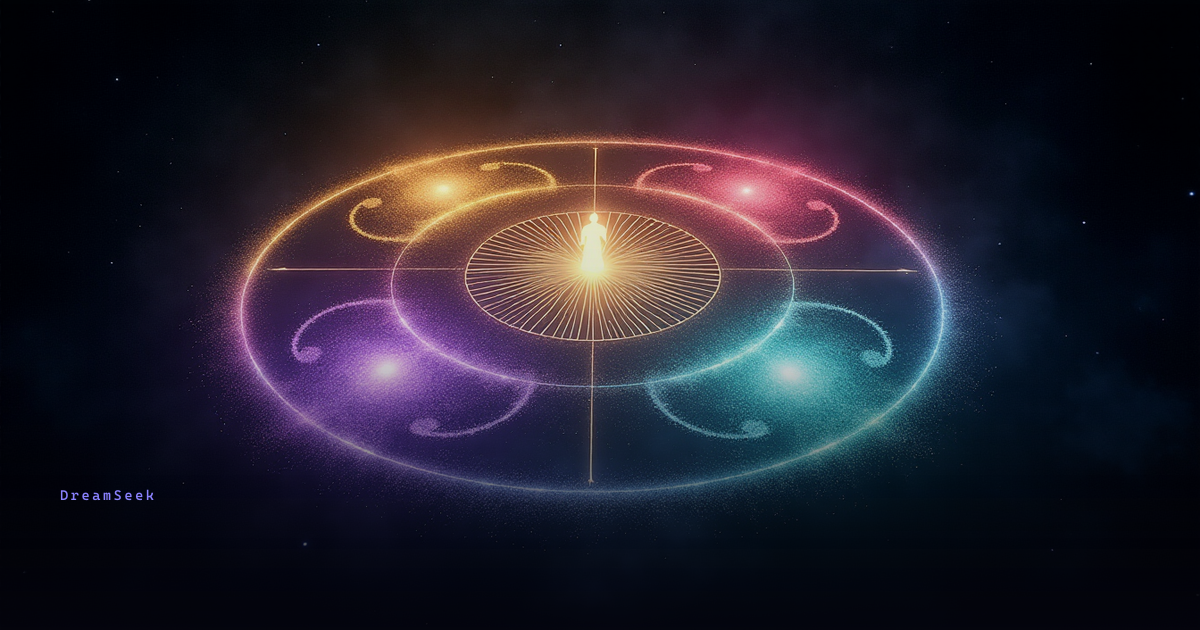
The medicine wheel dream meaning tradition offers one of the most elegant systems for understanding dreams ever developed on this continent. A circle divided into four quadrants, each associated with a direction, a color, an animal, a season, and a dimension of human experience — it is simultaneously simple enough to sketch on the back of a napkin and deep enough to organize a lifetime of inner work. If you have dreamed of eagles, bears, coyotes, or buffalo and felt the dream was trying to place you somewhere in a larger pattern, this framework may illuminate what your psyche is mapping.
But first, a necessary and genuinely important caveat. What follows draws from published, generalized sources — not from any single living tribal tradition. That distinction matters enormously, and we will address it directly before going further.
A Note on Cultural Sensitivity and Source Integrity
The "medicine wheel" as presented in popular dream interpretation literature is largely a pan-Indian generalization — a composite framework drawn from elements of multiple Indigenous North American traditions, assembled primarily for non-Native audiences. The two most influential published sources are Sun Bear and Wabun's The Medicine Wheel: Earth Astrology (1980) and Jamie Sams and David Carson's Medicine Cards (1988). Both were written for broad audiences and both have been criticized by some Indigenous scholars and practitioners for flattening the diversity of actual tribal traditions into a single marketable system.
What you need to know:
- Specific tribal traditions vary significantly. The Lakota medicine wheel is not the Ojibwe medicine wheel is not the Navajo medicine wheel. Color associations, animal correspondences, and directional meanings differ across nations. There is no single "Native American" system — there are hundreds of distinct traditions, many of which are not publicly shared.
- Pan-Indian generalizations are problematic. Treating all Indigenous North American spiritual systems as one unified tradition erases genuine cultural differences and can perpetuate colonial patterns of appropriation (Deloria, 1969; Smith, 1999).
- Living traditions are not the same as published accounts. The framework presented here comes from books written for general audiences, not from ceremonial instruction within a specific lineage. If you are drawn to this work and want to go deeper, seek out teachers from specific traditions who are willing to share, rather than treating published generalizations as authoritative.
- Respect sovereignty. Some ceremonial knowledge is intentionally private. The existence of published sources does not mean everything is meant for public consumption.
With these caveats genuinely held — not as a disclaimer to be skimmed past, but as an active frame — the published medicine wheel framework remains a powerful and widely used tool for dream interpretation. We present it here as what it is: a generalized synthesis from published sources, useful as a psychological map, and best held with humility about what it does and does not represent.
Evidence level: Ethnographic accounts, published oral tradition, anthropological reconstruction, and popular synthesis. No controlled empirical studies have tested medicine wheel dream interpretation as a system. Its value is as a symbolic and psychological framework, not as an empirically validated clinical tool.
The Dream Interpretation Engine includes the four-directions framework as one of its 12 interpretive traditions, mapping dream imagery to directional and animal correspondences while honoring the cyclical developmental model. It shows where medicine wheel readings converge with Jungian quaternity analysis and other fourfold systems on your specific dream. Try the Dream Interpretation Engine free →
The Four Directions as Psychological Dimensions
The medicine wheel maps human experience onto the cardinal directions. In the generalized framework drawn from Sun Bear and Wabun (1980) and Sams and Carson (1988), each direction carries a cluster of associations. When these symbols appear in dreams, they may indicate which quadrant of your psyche is active, calling for attention, or ready for development.
East: Illumination and the Eagle
Direction of: Spring, dawn, new beginnings, illumination, the visionary capacity Color: Yellow (in most published versions; varies by tradition) Animal: Eagle Element: Fire (or Air, depending on source) Psychological dimension: Clarity, overview, the capacity to see the big picture
Dreams oriented toward the East often involve flight, sunrise, open vistas, birds of prey, and moments of sudden clarity. If you dream of eagles, hawks, or of standing on a high place seeing a vast landscape below, the East quadrant may be activated.
In psychological terms, the East corresponds roughly to what Jung (1921) called the intuitive function — the capacity to perceive possibilities, to see beyond the immediate situation. East-dreams often arrive at the beginning of a new life phase, when the psyche is generating vision for what comes next.
Dream indicators: Bright light, dawn imagery, flying, high vantage points, eagles or other raptors, illumination, "aha" moments within the dream, the color yellow.
South: Trust and the Coyote
Direction of: Summer, midday, trust, innocence, the inner child, emotional openness Color: Red Animal: Coyote (the trickster, teacher through mistakes) Element: Water (or Earth) Psychological dimension: Vulnerability, playfulness, learning through experience, emotional truth
South-directed dreams involve water, play, trickery, being fooled or surprised, children, the body, sexuality, emotional intensity, and humor. The coyote is the trickster — the one who teaches wisdom through folly. If your dream involves being tricked, making embarrassing mistakes, or encountering absurd situations that are somehow deeply instructive, Coyote may be your teacher.
The South maps to feeling function in Jungian terms — the capacity for emotional valuation, for knowing what matters to you through felt experience rather than analysis. South-dreams often ask: Can you be vulnerable? Can you trust the process even when it looks foolish?
Dream indicators: Water, warmth, red hues, playful or trickster animals, children, embarrassment that teaches, emotional flooding, laughter, sexuality, the body.
West: Introspection and the Bear
Direction of: Autumn, dusk, introspection, the inner life, death-and-rebirth, the dream world itself Color: Black Animal: Bear (who hibernates — goes within) Element: Earth (or Water) Psychological dimension: Self-reflection, shadow work, the unconscious, digestion of experience
The West is the direction of the dream itself. Dreams within dreams, caves, dark forests, descent imagery, bears, and encounters with death all suggest the West quadrant. This is the territory of introspection — the bear who enters the cave of winter to digest the year's experience and emerge transformed.
In Jungian terms, the West corresponds to the feeling/introverted function complex — the capacity for deep inner work, shadow confrontation, and the psychological death-and-rebirth that Jung (1952) called the nekyia (night-sea journey). West-dreams are often the most disturbing and the most transformative.
Dream indicators: Darkness, caves, forests, bears, descent, death imagery, transformation, autumn/harvest imagery, black color, dreams-within-dreams, introspective solitude.
North: Wisdom and the Buffalo
Direction of: Winter, midnight, wisdom, the ancestors, accumulated knowledge, gratitude Color: White Animal: Buffalo (provider, abundance through sacrifice) Element: Air (or Earth) Psychological dimension: Wisdom, integration, elder consciousness, the long view
North-directed dreams involve snow, white animals, ancestors, elders, libraries, ancient landscapes, bone-deep knowing, and encounters with the dead who bring messages. The buffalo represents wisdom earned through sacrifice — the animal that gave everything to sustain life on the plains.
The North maps to thinking function in Jungian typology — but thinking in its wisest form, not mere intellect. North-wisdom is what you know in your bones after decades of living. It is the ancestor's voice in the dream, saying what the ego doesn't want to hear but needs to know.
Dream indicators: Snow, ice, white, ancestors or elders, ancient structures, libraries, bones, buffalo or large grazing animals, midnight, stars, silence, vast empty spaces, wisdom received.
Center: Integration and the Self
The fifth point is the center of the wheel — where all four directions meet. The Center represents integration, balance, the whole Self that contains and transcends all four quadrants.
Dreams of the Center involve mandalas, circles, being at the crossroads, four objects or four figures appearing together, and experiences of wholeness or completion. These are relatively rare and precious dreams — they suggest the psyche is achieving a moment of integration.
Animal Medicine in Dreams
The animal correspondences extend well beyond the four cardinal animals. In the system presented by Sams and Carson (1988), dozens of animals carry specific "medicine" — psychological teachings. While the specific correspondences are the intellectual property of those authors, the general principle is ancient and cross-cultural: animals in dreams carry teachings appropriate to their nature.
Some widely recognized associations from published sources:
- Owl: The capacity to see in darkness, seeing through deception, death/transition (associated with the West in many traditions)
- Deer: Gentleness, the ability to move through difficulty with grace
- Snake: Transformation, shedding what is outgrown, healing (a nearly universal symbol, shared with Greek Asklepian tradition)
- Wolf: The teacher, the pathfinder, loyalty to the pack/community
- Raven/Crow: Magic, the void, shape-shifting, messages between worlds
The critical principle: in this framework, when an animal appears in your dream, it is not merely a symbol to be decoded — it is understood as a teacher offering medicine you need. The dreamer's task is not to "interpret" but to receive.
The Wheel as Developmental Cycle
One of the most psychologically useful aspects of the medicine wheel framework is its understanding of development as cyclical rather than linear. You do not graduate from South (trust) and move permanently to West (introspection). Instead, you cycle through all four directions repeatedly, each time at a deeper level.
This maps remarkably well to empirical models of adult development. Kegan's (1982) constructive-developmental theory describes a similar spiraling process — each stage of development involves a new capacity for subject-object differentiation, but earlier stages are not abandoned. They are included in a larger integration.
A practical application for dream tracking: note which direction your dreams have been emphasizing over a period of weeks or months. If you have been dreaming primarily of bears, caves, dark water, and introspective solitude (all West imagery), your psyche may be in a West phase — a period of deep inner work. Knowing this can help you cooperate with the process rather than resist it.
Structural Parallels: Jung's Quaternity and the Kabbalistic Four Worlds
The four-directional model finds structural parallels in other traditions, which is worth noting without collapsing the differences.
Jung's four functions (thinking, feeling, sensation, intuition), arranged as a quaternity with the Self at the center, map onto the medicine wheel with surprising precision. Jung (1921, Psychological Types) arrived at his four-function model through clinical observation and study of Western philosophical tradition, apparently without direct knowledge of Plains Indian medicine wheel symbolism. The convergence may reflect a genuine archetypal pattern — the psyche naturally organizes experience into a fourfold structure with a unifying center.
The Kabbalistic Four Worlds — Atziluth (emanation), Briah (creation), Yetzirah (formation), and Assiah (manifestation) — describe a fourfold process of consciousness moving from pure awareness to material expression. Again, the structural parallel is notable without being evidence that these traditions are "really the same thing." They are not. They arise from radically different cultures, carry different meanings, and function within different practice contexts.
The honest interpretation: the human psyche may have a natural tendency to organize holistic experience into fourfold patterns. This makes medicine wheel, quaternity, and Four Worlds all independently valuable maps of a common territory — the territory of human consciousness seeking wholeness.
How to Map Your Dreams to the Medicine Wheel
A practical method, synthesized from published sources:
Step 1: Record the dream in full. Write everything you remember, including colors, animals, landscapes, time of day, and emotional tone.
Step 2: Identify dominant elements. What direction do the major symbols cluster toward? Use the correspondence tables above as a starting point, but trust your own felt sense — if a bear in your dream feels like an East experience (fierce clarity), honor that over the "official" correspondence.
Step 3: Notice what is absent. If you have been dreaming exclusively in one direction for months, the opposite direction may need attention. In the wheel, East and West are in polarity, as are North and South. Chronic one-sidedness in dream content may indicate a developmental imbalance.
Step 4: Engage the dream animal. If an animal appeared in the dream, spend time in active imagination (Jung, 1935) or embodied dialogue (Perls, 1969) with that animal. Ask it what it came to teach. Listen without analyzing.
Step 5: Track the cycle. Over months, notice the directional movement of your dreams. Are you spiraling clockwise through the wheel (the traditional direction of movement in many published sources)? Are you stuck? Has a new direction opened up?
The Lakota Vision Tradition: A Deeper Context
The most famous account of Indigenous North American visionary experience is Black Elk's great vision, recorded by John G. Neihardt in Black Elk Speaks (1932). In this account, Black Elk — an Oglala Lakota holy man — describes a childhood vision of extraordinary power and complexity, involving the six grandfathers (the four directions plus sky and earth), thunder beings, and a cosmic journey through the hoops of the world.
Black Elk's vision is specifically Lakota — not pan-Indian, not generic, not a medicine wheel teaching for general consumption. It belongs to a particular man, a particular tradition, and a particular historical moment (the destruction of Lakota life on the plains). Reading it as "Native American dream symbolism" strips it of its specific cultural weight and historical grief.
What Black Elk's account does demonstrate is the depth and sophistication of Indigenous dream and vision traditions — systems that were ancient and fully developed long before European contact, and that contain psychological insights Western psychology has only recently begun to approach.
Limitations and Honest Assessment
What the medicine wheel framework does well:
- Provides a holistic map that prevents reductive interpretation
- Honors the body, emotions, intellect, and spirit equally
- Treats dreams as teachings to be received, not problems to be solved
- Maps developmental cycles rather than demanding linear progress
What it cannot claim:
- There are no controlled studies testing medicine wheel dream interpretation against other systems
- The published framework is a popular synthesis, not a specific tribal teaching
- Correspondence tables (animal X = meaning Y) oversimplify what are, in living traditions, deeply contextual and personal teachings
- The framework has not been empirically validated as a psychological assessment tool
What intellectual honesty requires:
- Acknowledging that this is a generalized framework from published sources, held with respect but not confused with living ceremonial tradition
- Noting that its psychological value is real but anecdotal, not empirically established
- Recognizing that the traditions this draws from are living, sovereign, and not fully represented by any published source
Related Articles
- Celtic Dream Interpretation: The Otherworld Within — Another nature-based dream tradition with deep ecological symbolism, animal teachers, and a cyclical understanding of transformation.
- Jungian Dream Analysis: The Complete Guide — Jung's four-function quaternity maps onto the four directions with striking structural precision, suggesting a shared archetypal pattern.
- Tibetan Dream Yoga: The Complete Guide — The five Buddha families system shares the directional symbolism and color correspondences of the medicine wheel within a Buddhist contemplative framework.
The Dream Interpretation Engine analyzes dreams through 12 interpretive traditions simultaneously — including the four-directions framework. It maps your dream's animal presences, directional imagery, and seasonal symbolism to the medicine wheel while showing where these readings converge with Jungian quaternity analysis and other fourfold systems. Try the Dream Interpretation Engine free →
Frequently Asked Questions
What does it mean to dream of a specific direction on the medicine wheel?
Dreaming of imagery strongly associated with one direction — such as eagles and dawn for the East, or bears and caves for the West — may indicate that the psychological dimension associated with that direction is currently active in your development. In the published framework (Sun Bear & Wabun, 1980), each direction corresponds to a season of the soul. East dreams suggest new vision is emerging; South dreams suggest emotional learning and trust; West dreams suggest deep introspection; North dreams suggest wisdom integration. However, these are general guidelines from a synthesized framework, not rigid diagnostic categories.
Is it cultural appropriation to use the medicine wheel for dream interpretation?
This is a question that deserves genuine engagement rather than a simple yes or no. The published medicine wheel framework (Sun Bear & Wabun, 1980; Sams & Carson, 1988) was explicitly created for broad audiences, including non-Native readers. However, specific tribal ceremonial practices involving directional symbolism are often private and not intended for public use. The respectful approach: use published frameworks with humility, acknowledge their sources, do not claim to be practicing a specific tribal tradition, and if you feel drawn to deeper engagement, seek out Indigenous teachers who are willing to share within their own protocols.
How does medicine wheel dream interpretation differ from Jungian analysis?
Both systems use a fourfold model with a unifying center. Jung's four functions (thinking, feeling, sensation, intuition) map structurally onto the four directions. However, the medicine wheel framework emphasizes the cyclical and embodied nature of development — you move through directions seasonally, physically, in relationship with land and animal teachers. Jungian analysis tends toward the intrapsychic and mythological. The medicine wheel is also inherently ecological: it places the dreamer within a web of relationships with the natural world, whereas Jungian analysis, for all its depth, remains largely within the human psyche. Both are valuable; they illuminate different facets of the same territory.
What animals are most significant in medicine wheel dream work?
The four cardinal animals in the most widely published version are Eagle (East), Coyote (South), Bear (West), and Buffalo (North). However, any animal that appears in a dream may carry "medicine" — a teaching appropriate to its nature. The key principle is that the animal is understood as a teacher, not merely a symbol. Owl (seeing in darkness), Snake (transformation), Wolf (teaching/pathfinding), Deer (gentleness), and Raven (magic/void) are among the most commonly discussed in published sources (Sams & Carson, 1988). The most important animal in your dream work is the one that actually appears in your dreams.
Can I combine medicine wheel interpretation with other dream systems?
Yes, and the structural parallels with other fourfold systems (Jungian quaternity, Kabbalistic Four Worlds, Tibetan Buddhist mandala) suggest that combining frameworks can enrich interpretation. The medicine wheel excels at ecological and embodied mapping; Jungian analysis excels at mythological amplification; Gestalt work excels at embodied dialogue with dream elements. Many contemporary practitioners use a layered approach. The key is to respect each system's integrity rather than creating a shallow blend. Use the medicine wheel for what it does uniquely well — placing you within a cyclical, directional, animal-taught developmental map — and supplement with other systems where appropriate.